

Meet your implant dentist: Dr. Louis Abukhalaf
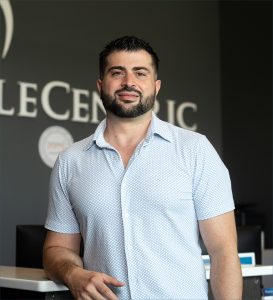
Dr. Louis Abukhalaf graduated magna cum laude from the Marquette University School of Dentistry. Before that, he earned his chemistry and biochemistry degree summa cum laude from Loyola University Chicago. He completed advanced implant training through the Misch International Implant Institute, the program founded by the late Dr. Carl Misch and widely considered one of the most rigorous implant programs in the country. He continues his postgraduate study at the Kois Center, focusing on cosmetic and implant dentistry.
For implant patients, the practical effect is straightforward: the dentist who plans your case, places the implant, and delivers the final crown is the same person, and that person has spent years specifically learning the surgical and restorative side of implant dentistry beyond general practice.
"Implants are the cases I find most rewarding because they bring all of dentistry together. Surgery, prosthetics, occlusion, and a long conversation with the patient about what they want their bite and their smile to feel like. The first job at the consult is to listen. The second is to show them on the 3D scan exactly what we are working with." Dr. Louis Abukhalaf
A complete picture of dental implant treatment
Single-tooth implants
A single-tooth implant replaces one missing tooth with a titanium post that fuses to the jawbone (a process called osseointegration), an abutment that connects to the post, and a custom crown on top. It is the closest match in look and function to a natural tooth that modern dentistry can offer. Unlike a traditional bridge, an implant does not require shaving down the two healthy teeth on either side of the gap. The neighbors are left alone.
Multiple-tooth implants and implant bridges
When you are missing several teeth in a row, you do not always need one implant per tooth. Two well-placed implants can support a fixed bridge that replaces three or four teeth, often at a lower total cost than placing an individual implant for each missing tooth. We will walk you through the trade-offs at the consultation.
Full-arch (All-on-X) implants for denture patients
Patients who have lost most or all of an arch can replace the full set of upper or lower teeth on as few as four to six implants (sometimes called All-on-4, All-on-6, or All-on-X). The result is a fixed, non-removable set of teeth that you brush and care for like natural teeth. For patients who have worn dentures and want them gone for good, this is usually the option that changes the most about daily life.
When you may need bone grafting first
Implants need a certain amount of bone in the jaw to hold them long-term. When teeth have been missing for years, the bone in that area can shrink. Bone grafting rebuilds the volume needed and lets the implant case proceed. Many patients who were told elsewhere they were not implant candidates turn out to be candidates after a small graft. The 3D Cone Beam scan at your free consultation will show whether grafting is needed and how much.
How implant treatment works at SmileCentric East
Step 1: Consultation and 3D Cone Beam imaging
Your first visit is a free implant consultation. We take a 3D Cone Beam scan, look at your bone volume and the position of nerves and sinuses, and talk through what you want the final result to look and feel like. You leave the visit with a written treatment plan and an itemized cost estimate.
Step 2: Placement (and bone grafting if needed)
Implant placement is done in our office under local anesthesia. Sedation is available for patients who want it. If your bone volume is not enough to hold an implant on its own, a small bone graft can be done at the same visit or as a separate step a few months earlier. The placement procedure itself is shorter and more comfortable than most patients expect.
Step 3: Healing
The implant integrates with your bone over roughly three to six months, depending on the location and your healing. During this period you wear either a temporary tooth or, in some full-arch cases, a temporary set of teeth. Most daily activities continue normally during healing.
Step 4: Final crown, bridge, or full-arch restoration
Once integration is confirmed, we attach the abutment and final crown, bridge, or full-arch restoration. We use Same-Day Crown technology when the case allows, so the final tooth can sometimes be delivered in one visit. Full-arch cases follow a slightly different timeline because of the additional planning and lab work involved.

How much do dental implants cost on the east side?
Single implant cost ranges
A single dental implant in the United States typically runs from about $3,000 to $6,000 once the implant post, abutment, and crown are all included, according to ranges published by the American Academy of Implant Dentistry. Bone grafting, when needed, adds a separate cost. The crown material chosen and whether sedation is part of the plan also affect the total.
Full-arch (All-on-X) cost ranges
Full-arch implant restorations cost substantially more because of the four to six implants, the larger restoration, the lab work, and the additional planning involved. Per-arch cost varies based on materials, the number of implants used, and whether bone grafting or sinus lifts are needed. We provide an itemized estimate at the consultation.
How insurance and financing work
We are in-network with most major PPO plans and we file claims for you. Many dental insurance plans cover part of an implant case (often the crown portion of a single-implant restoration) but few cover the full cost. We will review your plan with you and explain what is and is not likely to be covered before treatment is scheduled.
For uninsured patients, three options are available: a membership discount plan, OrthoFi monthly financing that splits the case across affordable monthly payments, and an itemized estimate that lets you plan exactly which parts of the case to do first. The free implant consultation is a no-pressure way to see your specific numbers before deciding anything.
Are you a candidate for dental implants?
Most healthy adults with one or more missing teeth are good implant candidates. Implants ask three things of your body: enough bone to hold the post, healthy gums around the site, and a healing system that is not impaired by uncontrolled diabetes, heavy smoking, or certain medications.
Bone grafting can solve the first problem when needed. Gum disease is treated first when the second is the issue. The third is something we will talk through honestly with you at the consultation. There are some patients for whom implants are not the right answer, and we will tell you straight when that is the case.
How to find our east-side office
Our office is at 115 North Shortridge Road, Suite 200, in the Irvington neighborhood of the 46219 ZIP code. We sit just north of East Washington Street (US 40) and just south of East 10th Street, with Shadeland Avenue to the east and I-465 a few minutes further east of that. Most major east-side and Hancock County routes feed into our intersection within a short drive.
A quick reference for the communities we serve most often:
- From 46219 (Irvington): you are already here. Most points in 46219 are five to ten minutes from our parking lot.
- From 46226 (Lawrence Township, Devington, Brendonwood): south on Shadeland Avenue to East 10th Street, then west on 10th to Shortridge. About ten to fifteen minutes.
- From 46229 (Cumberland): west on US 40 / East Washington Street, then north on Shortridge. About eight to twelve minutes.
- From 46235 (Cherry Lake area, Lawrence Township): southwest on Pendleton Pike, then south on Shadeland Avenue to East 10th Street, west to Shortridge. About fifteen to twenty minutes.
- From 46236 (Oaklandon, Geist): south on Olio or Carroll Road, west on 56th Street, south on Shadeland Avenue, west on 10th Street to Shortridge. About twenty minutes.
- From New Palestine: US 52 west and either Brookville Road into East Washington Street or I-74 to I-465 north. About twenty-five minutes.
- From McCordsville: south on Mt. Comfort Road, west on 56th Street, south on Shadeland Avenue, west on 10th Street to Shortridge. About twenty minutes.
Parking is on site and the office is on the second floor. If you are using GPS, the address is 115 N Shortridge Rd, Indianapolis, IN 46219.
Our East Indianapolis Dental Services Include:
Dental Implants Provider
Frequently asked questions about dental implants
How long do dental implants last?
Long-term studies of modern endosseous implants report success rates around 95 percent at 10 years and beyond when patients keep up with cleanings and home care. The implant post itself can last for life. The crown on top is a separate part and may need replacement once or twice over a few decades, similar to any other crown.
Does getting an implant hurt?
The placement itself is done under local anesthesia and most patients are surprised by how little they feel. Mild soreness for a few days afterward is common and usually managed with over-the-counter pain medication. Severe pain is uncommon and a sign to call us.
What if I do not have enough bone for an implant?
Bone grafting can rebuild the volume needed to hold an implant. Many patients who were told elsewhere they were not implant candidates turn out to be candidates after a small graft. Your 3D scan will show whether grafting is needed and how much.
Can I get implants if I currently wear dentures?
Yes. Many full-arch implant patients come to us already wearing dentures and ready to be done with them. The All-on-X options are designed for exactly that situation.
How long does the whole implant process take?
A simple single-tooth case from consultation to final crown usually takes three to six months because of the time needed for the bone to integrate with the implant. Cases that need grafting first take longer. Cases done with immediate-load full-arch protocols can have temporary teeth in place the same day, with the final restoration completed once healing is done.
What is the difference between a dentist who places implants and an oral surgeon?
Both can place implants. Some dentists place but do not restore (you go to one office for the surgery and another for the final crown). Some oral surgeons place implants but do not do the cosmetic case planning that the final restoration requires. Dr. Abukhalaf does both: he plans, places, and finishes the case, which means the surgical decisions are made with the final restoration already in mind.
Are dental implants safe for older patients?
Age alone is not a reason to rule out implants. Plenty of patients in their 70s and 80s have implant work done and do well with it. Overall health, bone volume, and the medications a patient is taking are more important than age. We have placed implants for patients across a wide age range.
Schedule your free implant consultation on the east side
If you are missing one or more teeth and want to know what implants would look like for your specific mouth, the consultation is free and there is no pressure to commit. Call us at (317) 777-7179or book online and ask for the implant consultation. We will see you on Shortridge Road in Irvington, and we will plan your case with the same care we have used for east-side patients for years.
Indianapolis New Patient Dental Specials
New Patient Exams
$59
No insurance? We offer a $59 Comprehensive New Patient Exam and X-Rays.
New patients only.
Cannot be combined with insurance.
New Patient Healthy Mouth Cleaning
$49
No insurance? We offer a $49 New Patient Exam Healthy Mouth Cleaning and Polishing.
New patients only. Cannot be combined with insurance. Includes a Healthy Mouth Cleaning in the absence of periodontal disease.
Dental Implant Consultation
FREE
No insurance? We offer a FREE Dental Implants Consultation
We offer multiple implant options to replace missing teeth.
Click here to learn more about our dental implant consultations.
Our Indianapolis Dental Practice Location

Office Hours:
Monday: 8:00 AM - 5:00 PM
Tuesday: 8:00 AM - 5:00 PM
Wednesday: 8:00 AM - 12:00 PM
Thursday: 8:00 AM - 5:00 PM
Friday: 8:00 AM - 12:00 PM
Saturday: Closed
Sunday: Closed